
A trampoline park sells time, not entries. The guest pays for an hour of jumping, and the whole economics of the venue rests on how precisely that hour is counted. Ten minutes lost per guest is dozens of unpaid hours a month.
Let's look at what a park needs on day one, what gets sold "for growth", and how time tracking should work so the till reconciles without the owner being on site.
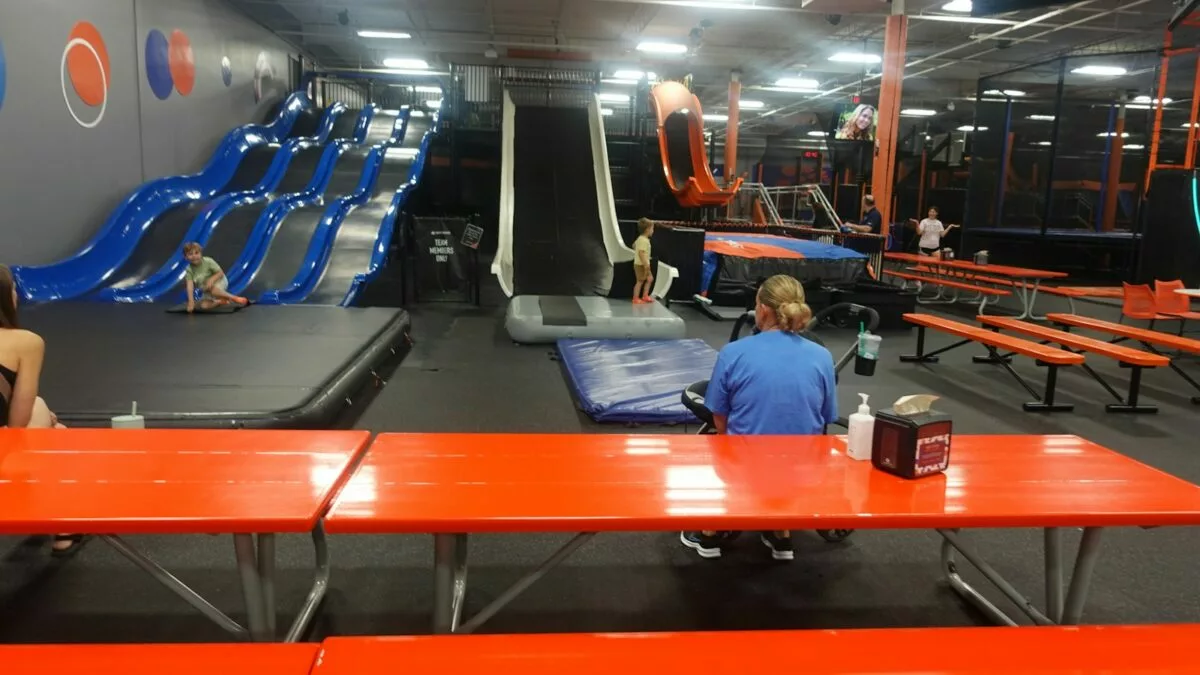
The unit of account is a minute, not a ticket
Ride-on car rentals count launches; a trampoline park counts minutes. The difference matters: a launch ends by itself, while time has to be stopped by someone. If nobody does, the visitor jumps an extra twenty minutes and the till still holds the price of one hour.
That is why trampoline park software needs not a "ticket" but a pair of actions: start and stop. Time should be counted by the server, not by the memory of the employee (job ads usually call this role an operator). Then the screen always shows how many people are inside and whose time is running out.
Wristbands, turnstiles and what you actually need at the start
Large systems offer a full kit: RFID wristbands, turnstiles, till hardware, integration with CCTV. All of it works, but it costs as much as a separate project and pays off with a queue that physically cannot be handled by one person.
A park with two or three zones does not need a turnstile. It needs answers to two questions: who is inside right now, and when does their time end. A wristband here is just a way not to mix up guests; a number written down at the start does the same job. Hardware is worth buying when the queue at the entrance has become a real problem, not in advance.
On the economics of the format itself — what it costs to open and where the money leaks — there is a separate piece: "Trampoline Center as a Business".
Two rates that cover almost every case
Per entry. The guest pays a fixed sum for a package of time — an hour, ninety minutes, unlimited until closing. The amount is known in advance, payment is taken immediately, and the clock runs for control.
Actual time. Time starts with a single tap and no payment, and the amount is calculated from the minutes actually spent at the moment of leaving. This suits places where the guest does not know in advance how long they will stay: came "for half an hour" with a child and stayed for two.
In RentOS both options live in the Stays mode: the employee starts the visit, sees a live counter and closes it on the way out. How to set it up is in the documentation: "Per entry" and "Actual time" rates. The mechanics are explained in detail in the article "Time Tracking".
Employees are the second largest cost after rent
Shifts in a trampoline park are long, there are more staff than in a car rental, and payroll takes a visible share of revenue. If shifts are counted in a chat and advances live in phone notes, by the end of the month nobody remembers who worked how much and who has already been paid.
A sensible minimum: the employee has an hourly rate, a check-in and check-out, advances and bonuses, and all of it adds up to a timesheet with a "to be paid" balance. Then payroll calculates itself instead of being reconstructed from memory. Details are in the piece "Shifts, Rates, Advances".
Reconciling the till at the end of the day
The day's total in a trampoline park is made of three streams: time, goods at the counter (socks, water, coffee) and passes, if you sell them. Everything has to add up together but be checked separately, otherwise it is impossible to tell where the shortfall came from.
In RentOS time is counted by zone, products keep their own till, and the discrepancy is shown as a separate line. The owner sees the number the same evening, wherever they happen to be. How the money is split is in the article "One Journal for Everything".
A checklist for a park with two or three zones
- Time starts and stops in the app, not in the employee's head.
- You can see who is inside right now and whose time is running out.
- Both rates exist — per entry and by actual minutes.
- Goods from the counter are counted as a separate till.
- Employee shifts and advances are kept where the revenue is.
- The owner gets the day's total without driving to the venue.
Frequently asked questions
Do I need wristbands? Not necessarily. A wristband is convenient with a flow of guests, but the task — not mixing people up — is solved by a visit number as well. You can start without them and add them when the flow grows.
What if a guest left and the time was not stopped? The visit stays open, and the zone will not let the day be closed until it is finished. That is exactly the safety net against "forgot".
Can I run a trampoline park and other formats in one place? Yes, if the software counts zones separately. In RentOS a trampoline park can run on time while the ride-on cars next door run on counters; the revenue adds up as one.
You can see what the system is made of and what it costs on the features и pricing.
Passes and regular guests
A trampoline park lives on repeat visits: the same child comes every week, often with the same parents. A pass works better than a discount here — the money is paid in advance and spent on visits.
Technically it is a balance tied to the client's phone number: topped up with a sum, then every visit reduces it. The owner gets prepayment and predictable repeat revenue, the client gets the feeling that it is "already paid for" and comes more often. How it works is explained in the article "Client Balance".
Three questions for the software vendor
- What happens if an employee forgets to finish a visit? The right answer is that the system will not let the day be closed and will show exactly which visit stayed open.
- How is the discrepancy calculated? There should be a separate figure, "calculation minus till", not just the sum of sales for the day.
- What does the owner see when they are not at the venue? If the answer is "log into the dashboard and export a report", nobody will use it in the evening.
The fourth question is worth asking yourself rather than the vendor: how many zones do you plan a year from now. Systems built for a single hall cope badly with a second site, and you will have to move together with your history.
 Русский
  English
  Українська
  Italiano
  Română